
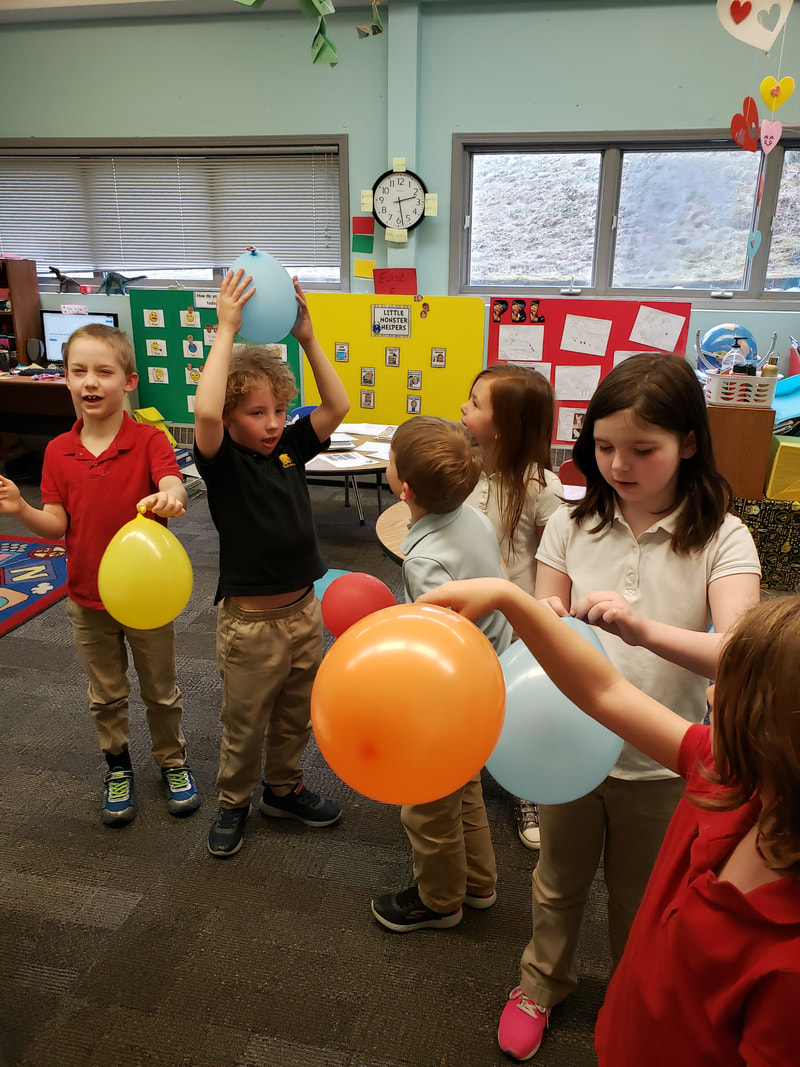
Early this week 1st Grade had music upstairs. At the end of the lesson as we were lining up to leave the class I heard a loud snap followed by a startled “ow!”. These were the telltale signs of static electricity claiming yet another unfortunate victim. What I was not expecting was that after getting shocked once, the student in question tried to figure out how to get shocked again. In very short order the whole class was shuffling their feet or rolling on the carpet then touching something metal trying to give themselves a shock. Not wanting to stand in the way of natural inquisitiveness and curiosity; and realizing there may perhaps be a better way to learn the science behind the shocks then purposely zapping ourselves, we headed back to our class to expand upon this teachable moment.
Science loves tricky words and when learning about electricity there is no shortage of these ‘technical vocabulary’ words to learn. It certainly puts own phonics and reading skills to the test. But learning these words and using them correctly is important for budding scientists. Some words we are using this week are; charge, static, current, atoms, positrons, electrons, neutrons, transfer, circuit and electricity.
Our first experiment using static electricity was focused around a simple question with perhaps a not so simple answer. Can you bend water?
So next time we are leaving music and I hear the telltale signs of static electricity claiming another victim I can turn around and say. “At least you know why you got shocked!”