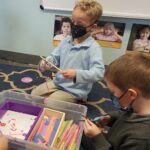
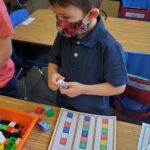
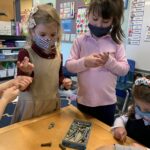
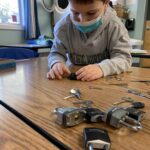
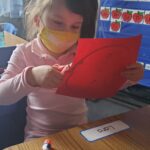
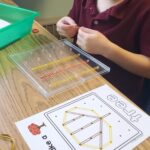
We have been having so much fun in the Beluga class as we have been learning about fall! We began our study of leaves with a leaf hunt around the PNA playground. As we walked, we talked about the things we could notice with our senses: the sight of the different colors of leaves and grasses, the damp and slightly sour smells of the woods, hearing crunch of the dry leaves, and the feeling different textures of the various kinds of leaves. Examining all the different kind of leaves easily led into our math focus for this week, which has been “sorting by attribute”. We also used acrylic leaves and other fall items to practice this important skill, as we talked about color, shape, size and other features. This quickly became a very popular center! We also learned how to use a stapler to fashion crowns from the leaves we had collected by stapling them to a strip of paper.
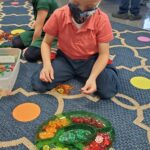
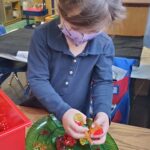
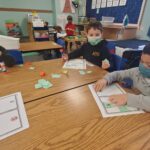
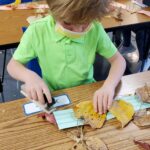
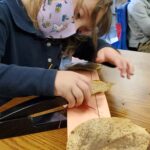
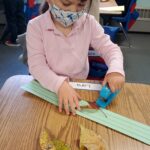
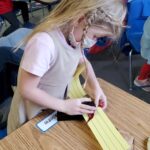
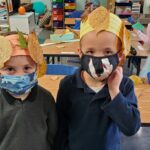

There are several literacy skills which we have been focusing on this week, including listening for the beginning sounds in words, as well as listening for rhyming words. We also played games to help us increase our letter recognition skills, and we also spent a good deal of time matching uppercase and lowercase letter “buddies”. We read MANY books about fall and leaves, and in the Nursery Rhyme “Old Mother Hubbard” we learned what it means when it says that “the cupboard was bare”!
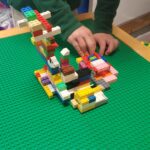
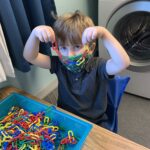
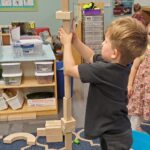
As teachers, we try to make all of our activities engaging so that the children see them as “just playing”. The activities we choose, however. are almost always carefully selected to accomplish underlying developmental or educational purposes. For example, there is an unbelievable number of fall activities which can be done in a preschool setting, but this week we specifically chose many of our activities with the goal of helping to strengthen the children’s fine motor skills.
Motor function refers to the ability of the body to coordinate movement. Most of our movements we do without much (if any) thinking, yet each movement requires the careful and amazing coordination of brain, muscles, and nervous system. We don’t pay them much attention unless they are impaired in some way, such as through an injury, or if they are not developing in a child as they should. These skills, which are usually categorized gross and fine, develop in children in a fairly predictable progression – generally from the center of the body outward. Large muscle function (gross motor) begin to develop first, and requires coordinating the muscles of the torso, legs and arms. Fine motor skills require small, controlled movements and a high degree of hand-eye coordination, and these skills begin to develop as a child reaches for toys to examine or carefully picks up bits of food they want to eat.
Fine motor skills utilize the small muscles of the fingers and hands, and they involve strength, control, and dexterity. They enable an individual to grip and manipulate objects, use both hands simultaneously and also changes grasps to manage different tasks. Fine motor skills aren’t specific “learning” skills like reading or math, but they are critical for many school-related tasks, as well as many important life skills! These include:
- Holding a crayon or pencil
- Drawing pictures and writing neatly
- Using scissors
- Stacking blocks, stringing beads or building with Legos
- Buttoning or zipping clothing and tying shoelaces
- Eating (i.e. opening containers and wrappers, peeling fruit)
The strength and coordination of these muscles will significantly influence the ability of a child to properly grip a writing instrument in order to properly form letters. A child who uses a palmar grip (closed fist) rather than a tripod grip (or if their tripod grip isn’t well-formed), will end up moving the writing tool by moving his shoulder and entire arm. The improper fist grasp requires extra effort, which in turn creates fatigue in the shoulder, arm and hand. A child who uses a closed fist grasp will tire easily and struggle with such tasks as writing, coloring and using scissors.
Because of the great importance of fine motor strength and coordination to help prepare children for an increasing amount of writing in their school career, early childhood teachers spend time monitoring a child’s progress in this area, and we are always looking to implement activities which will help develop these skills. The trick is to make these activities as fun as possible, so they don’t even know they’re doing something that’s good for them!