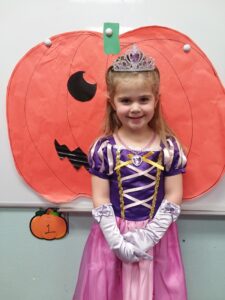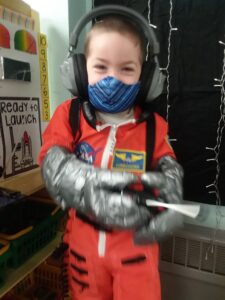
“Watch out! The floor is lava!” How many of us have played this or similar games in our childhood? The month of October has given the Orca class a great opportunity to hone our imaginative skills. Having a healthy imagination is critical to a well-rounded childhood and can help in developing so many key skills that will lead to a healthy adulthood. Imaginative play allows children to role-play scenes and issues that they may see or  encounter in their everyday lives. These scenarios help in developing social and emotional skills, creativity,
  physical skills, language and communication skills, and problem solving.
- Social and Emotional Development: Imaginative play gives students many opportunities to work together with others in role-playing situations where they need to learn how to voice their concerns, opinions, or give directions. Acting out stories can also teach valuable lessons about getting along with others. This month, our class learned how to send messages to each other to inform others of our needs, wants, or interests. To punctuate this lesson we enjoyed acting out the story of Little Bunny Foofoo. Each child got a role in the story. At the end we discussed the message that that good fairy gave to Bunny Foofoo and each child got to imagine a different scenario where Foofoo did listen to the fairy’s message.
- Creativity: Imaginative play can be anything as complex as a whole costume and play set that allows
 a child to immerse themselves in a make-believe world to as as simple as a few building blocks ready to launch a child into a career as a wold famous photographer.
 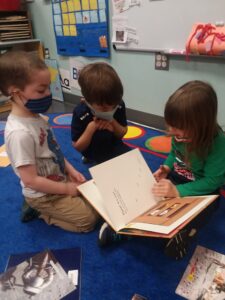 All that either of these require for hours of endless fun and learning is a spark of imagination from the brain.
 - Physical Skills: Pretend play can become fairly physically involved and help develop both fine and gross motor skills. Whether you are a perfecting your dance moves, hopping like a rabbit, creating snow angels, or finely engineering a crane or a race car motorway your muscles are at work.
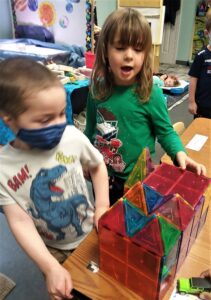
- Language and Communication Skills: Imaginative play can help children develop their communication skills and vocabulary as they explain their marvelous creations to others. Imaginative play also includes immersing in story land. Reading often begins by studying, interpreting, and retelling that which they find in storybooks.
- Problem solving: Children do lots of problem solving during
 imaginative play as they learn how to work with and
 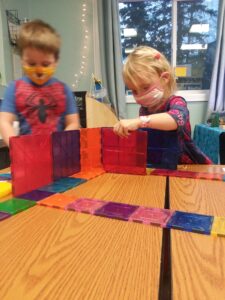 share materials with others and as they lean how to fix or improve upon their creations.
October was the perfect month to focus on imaginative play as we ended the month with the ultimate imagination party, our Halloween Party! From dinosaurs to princesses to frogs to vampire ballerinas to cute snowflakes to the Flintstones, we were all in!