
-
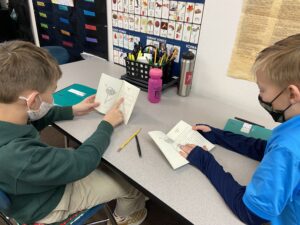
- Reading El Capibara con Botas
-
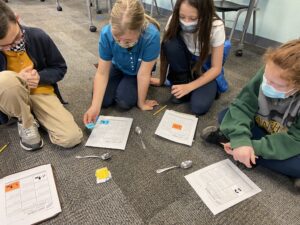
- Playing Arcoiris and Spoons mixed together.
-
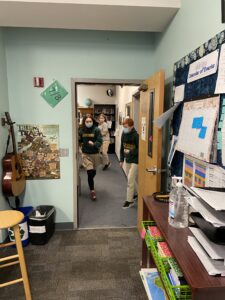
- Run to tell your partner the line!
-
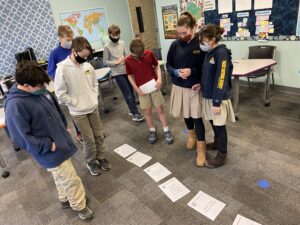
- Put the story line in order
Linguist Stephen Krashen was one of the first researchers to demonstrate clearly that reading massive amounts of written, comprehensible input is one of the most effective ways to acquire language. We know that students (and adults) who read a lot have better vocabularies in their first language, and their vocabulary continues to grow and improve over their lifetimes.
When people are acquiring a language, though, they don’t have much ability to start with, and it can be a challenge to find compelling reading that repeats vocabulary often. Parents of fifth-graders may know that we have started to read our first novel of the year. It is about a capibara who has special boots! It builds very slowly on a small set of vocabulary and introduces information about South America in limited amounts. The author’s notes and the slow progress help a teacher make sure that students hear and read, then use in writing the necessary structures over and over and over again.
What do we use when we have a limited text but still want to make sure that students read it multiple times to acquire the language it uses? We can offer different activities during which the students continue to repeat the language while keeping them engaged. Pictures from the last two weeks show students playing various games: in one, they must repeat sentences before laying down cards with appropriate photos. During “Running Dictation,” students run into the hall to read statements from a story and come back to dictate to their classmates. Once they have the statements written down, they have to put them in order. Finally, the whole group discusses the order of the statements.
These activities give students many opportunities to read at the instructional level, to practice using the language, and – most importantly – to work together to acquire the language in a community.