“Why do I need to learn this” “Why should this matter to me?” These are the questions of the ages! Since the beginning of time, students have pressed their teachers for the why’s and how’s and what’s of their learning. Sometimes they feel connected to the lesson; other times the topic feels useless. More often than not, this is due to the fact the lesson idea or concept is abstract and therefore seems irrelevant to them. Here at PNA, we strive to take the abstract and make it hands-on. Through our use of special projects and PBL (project-based learning) what was once abstract comes to life. It is in these moments that true learning begins.
Fourth graders have been working through the next major science milestone in our year – the earth sciences. We have been spending our time learning about rock cycles, erosion, and natural hazards. For many students, this became a “why do I need to learn this?” moment. Following our extremely fun animal adaptations unit and our creature creator project, learning about rocks seemed a little…tired. However, learning about rock patterns, rock layers, formation of fossils and erosion is part of the fourth grade standards. (4-ESS1-1 and 4-ESS2-2). So, the question became how DO we make it relevant. The answer was simple. Only by doing can an idea shift from abstract to practical and an irrelevant idea’s effects on our current world make sense.
 .
.
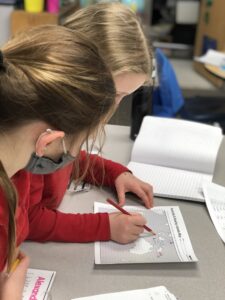
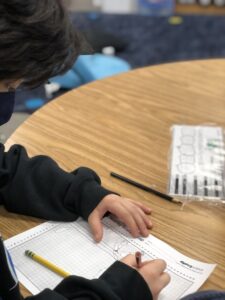
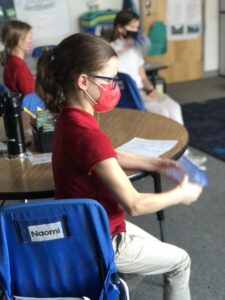
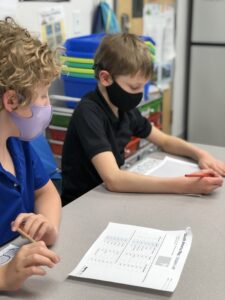
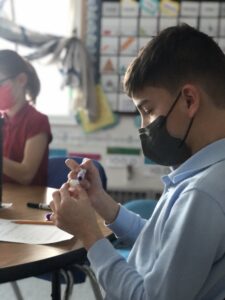
We began by exploring the discovery of the Ashfall Fossil beds and hypothesizing how these fossils got there. By doing some thorough research it was discovered that these fossils were in fact on a line of once active volcanoes. The ideas began rushing in as to what happened to these animals. Just as quickly as the ideas rushed in, so did the questions. How did the volcano bury them? Is the volcano still active underground? Why couldn’t the animals get away? More learning took place to identify types of volcanoes and then the hands-on work began. Students got to experiment with two different types of lava; thick and thin. Using this knowledge students figured out which lava belonged to which type of volcano and which volcano was the cause of the Ashfall Fossils beds; shield or cone. Once these questions were answered students were posed with another one – if lava buried the animals and years and years of more rock and sediment covered them, then how did we get to find them at all? What happened?
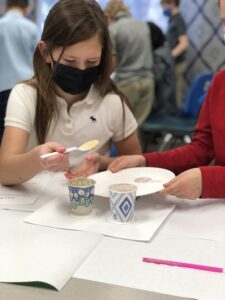
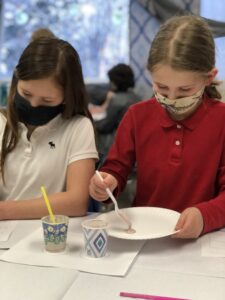
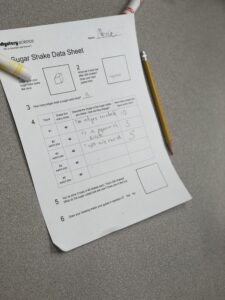
Some simple experiments with sugar cubes and shaking, imitating rocks rolling and moving over years unearthed the final answer in this puzzle – erosion. Erosion is a constantly evolving cycle and the final piece to our mystery. Through constant discovery, both researching and hands-on students led their way to the “why” and “what” of this earth science topic. Next up, let’s see how they tackle their next mission – “What would you do if your home was in the path of landslide?” Architects, engineers, geologists – we will tap into all these skills as earth science moves on.
 .
.