
-
- The fish who barked
-
- The most important lines
-
- What’s most important?
What do counting and drawing have to do with each other in a Spanish classroom? If you take a look at your student’s Spanish notebook, you might find a lot of pictures. Some will be in grids, usually numbered one to nine, looking like a bingo board.
Why are there drawings to begin with? They show the teacher what the student has understood. Typically we are telling, or sometimes asking, a story in Spanish class. “Asking” a story means that there is a set outline, rather like a Mad Lib. In order to give students autonomy in the classroom, students get to direct parts of the story.
The stories you may hear about are different from what you might find in a textbook. The fifth-graders created a story about an axolotl who wants dinosaur-shaped nuggets but is unable to find them in a yoga class. The sixth-graders introduced two beings. One is a tree named Kennadi who is crazy in the wind (and is passionate about chicken nuggets), and the other is a shark named Rienzi who wears a scarf while swimming very fast. And the seventh-eighth grade class described a meeting between Owen and Dr. Phil. Our mythical Dr. Phil was not kind to Owen.
Once the class has developed the story, we write it together. An advanced students might type for the teacher, but we always have one person whose job it is to record the information in a notebook for review. These two activities — discussing and then writing — allow the teacher to keep repeating critical new vocabulary over and over in different ways.
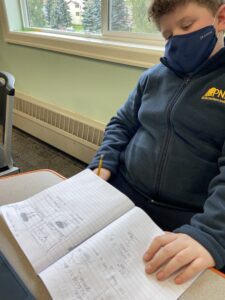
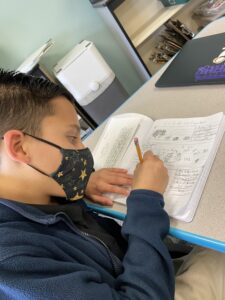
Next, we read the story together and might have a quiz to assess comprehension. Students illustrate the story. If we’re using a grid, the story line fits into the grid spaces, usually sentence by sentence. This practice gives students yet another chance to hear the vocabulary in a slightly different context.
Once the drawings are in place, the teacher reads the story out of order, and students respond with the number of the box that illustrates a given line from the story. Now they have to visualize. Strong readers and listeners visualize what they read and hear. When students hear the text, visualize the picture, and then respond by labeling, they have created a more lasting connection between the words and the meaning. And of course there has been even more repetition.
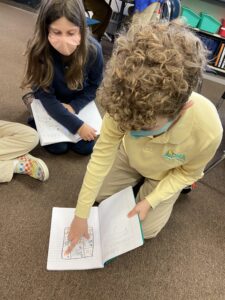
By now, some students are ready to retell parts of the story out loud. When they point at the pictures in their small group, everyone has support to understand what is being said. Students may be able to help one another because they know what the others want to express.
This process leads to students’ being able to comprehend a text both aurally and in writing. They support their classmates and enjoy any changes their peers have made to original stories. Working together strengthens their community, and yet students are challenged at the level they choose. A beginner may just listen to others and point at pictures appropriately. A more advanced student might talk about just one picture, and another might retell an entire story. Just like children in a family, every student in a Spanish class is at a different level of language acquisition, and having options for response lets students progress at their own speed.